
There is a jar of moisturizer sitting in the tomb of a wealthy Chinese nobleman from around 700 BC. It was made of animal fat, sealed, preserved, and apparently important enough to be buried with him. Which is a wonderfully efficient reminder that men caring about their skin is not new. The taboo is.
Because somewhere between ancient grooming rituals and 20th-century advertising, the West invented a strange idea: that men having skin was normal, but men caring for it was vaguely suspicious.
That fiction held for a long time. Long enough to shape entire industries, entire generations, entire performances of masculinity built around indifference, roughness, and the deeply unserious belief that a man could use aftershave but absolutely not moisturizer.
Now, finally, that idea is falling apart.
The men's skincare market is worth billions, still growing fast, and increasingly powered by a generation that never found the old stigma especially convincing. More men are using skincare openly, younger men are adopting routines earlier, and the category has moved from niche to normal with surprising speed.
Which raises the more interesting question: where did the stigma come from in the first place?
The myth was never ancient
The no-products, no-fuss version of masculinity that dominated Western culture for much of the 20th century likes to present itself as timeless. It wasn't. It was manufactured.
Historically, men have moisturized, perfumed, powdered, steamed, scrubbed, and generally done quite a lot in the name of appearance and care. Ancient Egyptian men used cleansing creams and scented oils. Roman men bathed publicly and treated skincare as standard maintenance. Aristocratic European men wore powder and perfume without suffering any visible collapse of identity.
The idea that skincare was somehow unmanly was not inherited from history. It was built much later, then reinforced so aggressively it began to feel natural.
Products could soothe, protect, defend, control. They could not nurture, soften, brighten, or glow, because that would have required acknowledging that men might care about their skin for reasons other than social survival.
So the category narrowed itself. Men were offered grooming, not beauty. Maintenance, not pleasure. Function, not care.
A false distinction, obviously, but a durable one.
The permitted ritual
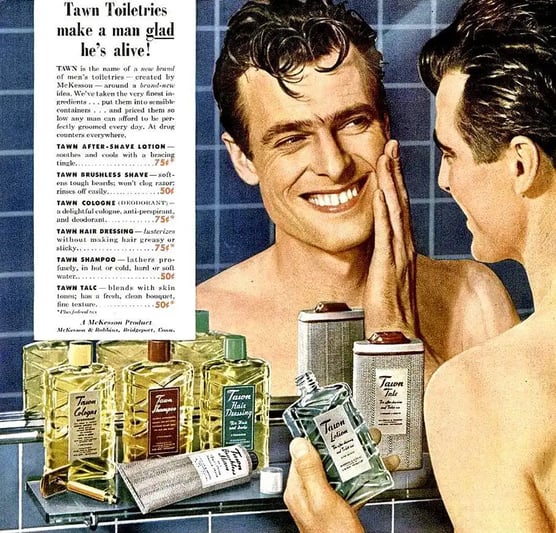
For decades, shaving was the one acceptable grooming ritual men could perform openly without seeming too interested in their own appearance. It was useful, masculine, and daily, which made it culturally safe. Entire brands were built inside that permission slip.
Aftershave could exist because it followed a razor. Cologne could exist because it signaled virility. Skin care, if it appeared at all, had to disguise itself as something else. Relief. Defense. Oil control. Performance.
Care was always there. It just could not be called care.
That is what made the whole thing so absurd. Men were using products all along, only under different names and with slightly more defensive posture.
If a man in the 1980s used moisturizer, he often kept it private. Researchers later described this dynamic as invisible consumption, which is exactly as bleak as it sounds: using the thing, benefiting from the thing, and still feeling you had to hide the fact that you wanted your face not to feel like sandpaper.
The demand existed. The industry saw it. It simply took a very long time to speak to it honestly.
The first crack in the wall
The early 2000s gave us the metrosexual, a term that now feels dated enough to require light archaeological handling, but was important for what it revealed.
The word existed because the behavior needed cover. Men were clearly interested in grooming, skincare, clothing, and appearance, but culture still required a category to make that interest legible. You could not simply have men taking care of themselves. You needed a sociological label, preferably one that reassured everyone involved that masculinity had survived the experience.
David Beckham became the defining reference point. A global athlete, visibly styled, highly groomed, undeniably masculine by every conventional standard, and therefore useful as proof that caring how you looked did not automatically move you outside the acceptable frame.
That mattered.
Not because Beckham invented men's grooming, but because he made it easier to be seen doing it. He expanded the range of what masculinity could hold without requiring a collapse of the whole performance.
Brands noticed. Men's product lines expanded. The language remained cautious, still heavy on solutions, defense, control, and anti-aging. You were not moisturizing, exactly. You were combating environmental stress. You were not exfoliating. You were deep-cleaning.
Clumsy, but effective enough to keep the category moving.
Then K-beauty changed the reference point entirely
While Western markets were still negotiating whether it was acceptable for men to use a face wash that was not attached to a razor, South Korea was operating from a completely different script.
There, skincare had never been trapped behind the same rigid wall between masculinity and care. Men using multiple steps, BB cream, sheet masks, or targeted products was not treated as a philosophical crisis. It was simply grooming in a culture that understood skin as something you maintain.
That difference mattered globally once K-pop and Korean beauty culture moved into international consciousness. Suddenly millions of people were looking at male celebrities with luminous, carefully maintained skin and seeing not a compromise of masculinity, but desirability at full volume.
And once that question takes over, a lot of very old anxieties start looking embarrassingly flimsy.
Social media did the rest
What K-beauty shifted culturally, social media scaled operationally.
Visibility is one of the fastest ways to kill shame. Once millions of men can watch other men discussing SPF, retinoids, niacinamide, and breakouts without irony, the behavior stops feeling fringe and starts feeling ordinary.
That is what platforms like YouTube and TikTok did for men's skincare. They removed the secrecy. They made routines visible, product use normal, ingredient literacy social, and self-care something men could participate in publicly without elaborate explanations.
This matters more than it sounds.
Stigma relies on isolation. It survives by making people feel singular in a behavior that is actually widespread. Once men could see athletes, creators, actors, and entirely average people using skincare openly, the old workaround of invisible consumption became less necessary.
The category no longer needed permission. It had momentum.
Why the market finally listened
At a certain point, ideology gives way to revenue.
The business case is now impossible to ignore. Men's skincare is no longer a side shelf or a novelty segment. It is a large, growing category with real adoption, especially in facial care, moisturizers, and products positioned around skin health rather than vanity.
That growth has triggered acquisitions, subscriptions, digital-native brands, and an entire wave of companies built around making skincare feel easier, more legible, and less culturally loaded for male consumers.
The subscription model, in particular, solved a real psychological problem. It let men acquire routines without having to stand under fluorescent lighting in a beauty aisle wondering whether they looked lost. The products arrived at the door, the awkwardness removed, the entry barrier lowered to almost nothing.
At the same time, brands leaned into something genuinely useful: men's skin does have physiological differences. It tends to be thicker, oilier, more sebum-rich, and regularly compromised by shaving. That science gave the category a more comfortable frame. Skincare could be presented not as vanity, but as specificity.
And in fairness, that part was true.
Browse products reviewed by the communityGen Z broke the script
Every generation moved the category forward a little. Gen Z changed the tone completely.
For younger men raised online, surrounded by broader expressions of masculinity, visible queer culture, K-pop, and an internet where information about skincare is everywhere, the old question of whether skincare is masculine barely lands. It sounds antique. Slightly embarrassing. Not serious enough to merit debate.
That generational shift may be the most important one.
Because older men often needed permission. Younger men mostly need information.
They know the ingredients. They know the basics. They understand sunscreen, barrier support, hydration, acne treatments. They are far more comfortable building routines without framing the whole thing as exceptional. What changed was not just adoption, but literacy.
And literacy is difficult to reverse.
A man who understands what retinol does is not especially likely to go back to pretending a bar of soap is a complete worldview.
The stigma is not dead, but it is losing
There are still remnants, of course.
Men still respond better to words like grooming and skincare than to beauty. Packaging still matters. Dark bottles, clinical labels, mechanical names, and "lab" branding continue doing a lot of cultural work. The product can moisturize exactly the same way, but it apparently helps if the bottle looks like it was designed by an architect with trust issues.
Fine. Pragmatism is still progress.
But the deeper shift is already locked in. The men who are young now will age into the category without carrying the same embarrassment around it. They will use sunscreen openly, recommend products to friends, teach better habits to their children, and treat skincare less as a gendered dilemma and more as routine maintenance with upside.
That is not a trend cycle. That is a cultural reset.
What this really means
The most interesting version of this story is not that men's skincare became a good business. It is that one very specific model of masculinity finally started to loosen its grip.
Because the old stigma was never really about cleanser or moisturizer. It was about teaching men that indifference to the body was a form of toughness. That care needed camouflage. That attention to your own face had to be justified, translated, or hidden.
That performance came with costs. Men have worse sunscreen habits. Higher rates of preventable skin damage. More reluctance around care, maintenance, and visible attention to their own health. Skincare was only one corner of a much bigger script, but it was a revealing one.
What is changing now is not just a shopping habit. It is a permission structure.
And once permission becomes normal, whole categories change very quickly.
Men never stopped having skin.
The West just took an astonishingly long time to let them act like it.